The following advertisements will be appearing for the first time in the October 2023 issue of Informer. (The images are clickable links.)



The following advertisements will be appearing for the first time in the October 2023 issue of Informer. (The images are clickable links.)

If your non-fiction book on crime history was recently published (2022 or 2023) or is soon to be published (2023 or 2024), please email a press release about it to informerjournal@gmail.com .
(Include a description of the book's subject, how your handling of it is different from other works on the subject and a few notes about you. If a photo of the cover is not available online, you should send one of those as well.)
Informer will publish a collection of brief book announcements - as space permits - in the upcoming October 2023 issue.
Due to the KDP printing service's escalating costs for materials and labor, the list prices of Informer paperback (Oct 2020, Oct 2021 and Nov 2022 issues) and hardcover (Nov 2022 only) book editions recently increased slightly.
For example, the October 2022 "Mob in Youngstown" issue in paperback form was originally priced at $19.95 (U.S. dollars). After the price increase, it is now for sale at $20.20 (USD).

The pricing for Informer's magazine format and for electronic magazine and electronic book formats have been unaffected by this price increase.
The October 2023 issue of Informer will focus on the gangsters of New York City's Lower East Side.

Journalists Craig Thompson and Allen Raymond, writing back in 1940, stated that "...the lower East Side of Manhattan in the first twenty years of the twentieth century was the greatest breeding ground for gunmen and racketeers, since risen to eminence, that this country has ever seen..." (Gang Rule in New York)
The pre-Prohibition Twentieth Century Lower East Side, discussed by Thompson and Raymond, certainly experienced an explosion in gangs and racketeering. But that was just a small part of the exciting and bloody underworld history of the region. In its 2023 issue, Informer will examine the gangland figures and stories from the Civil War Era through the end of the Prohibition Era.
We are currently seeking researchers/writers to help define and tell these stories. If you'd like to contribute to the issue, contact Informer (ASAP) with your article ideas at informerjournal@gmail.com.
The deadline for article submission is August 1, 2023.
The advertising deadline for the issue is August 22, 2023.
The issue will be released before October 3, 2023.

Sale price has dropped for Informer's 2022 audiobook,
The Mob in Youngstown.
Originally listed for $27.50 (USD), the audiobook is now listed on Google Play Books for $18.00 (USD).

Click here to visit the audiobook sale page.
November 2022 Issue Announcement
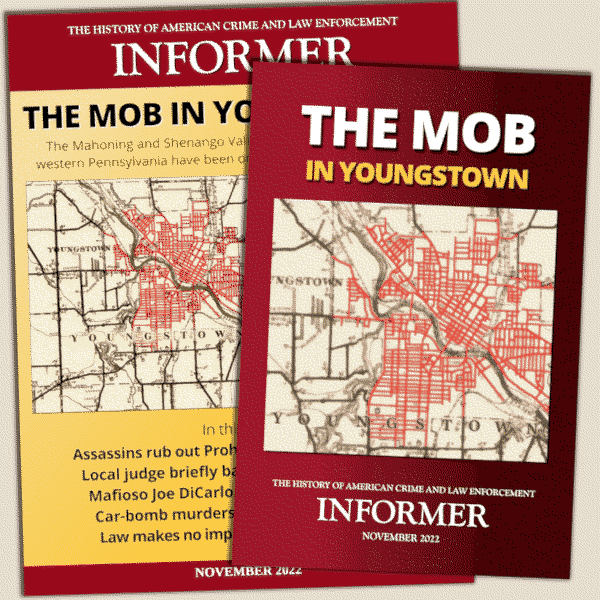
All print and electronic formats of the November 2022 issue of Informer are now available for preview / purchase. View the issue introduction for an overview and a summary of included articles. Or use the table below to find the format that best suits you.
| Type | Identifier | Dimensions | Color? | Seller | Price (USD) |
|---|---|---|---|---|---|
| MAGAZINE LAYOUTS | |||||
| Print Magazine | ISSN: 1943-7803 |
8 1/4" x 10 3/4" 188 pg incl covers |
Yes |  MagCloud |
$44.70 |
| PDF EMagazine1 | ISSN: 1944-8139 |
N/A | Yes | MagCloud |
$10.95* |
| BOOK LAYOUTS | |||||
| Print Hardcover2 | ISBN5: 9798849815220 |
6" x 9" 378 pages |
No |  Amazon |
$26.85 |
| Print Paperback2 | ISBN6: 9798351244709 |
6" x 9" 378 pages |
No | Amazon |
$19.95 |
| Kindle EBook3 | ASIN: B0BDFT9C9C |
N/A | No |
Amazon |
$9.95 |
| EPUB EBook4 | GGKEY: EYCX505E9B9 |
N/A | No |  GooglePlay |
$9.95 |
| AUDIOBOOK | |||||
| Audiobook7 | GGKEY: 48QRTHAQBHN |
10hrs:22mins | N/A | GooglePlay |
$18.00 |
|
1 - PDF document reader - such as Acrobat Reader - required. 2 - The printed books are indexed. (Ebooks/Emagazines can be searched.) 3 - Kindle device or Kindle reader software required. 4 - EPUB device or reader software - such as Calibre - required. 5 - Print hardcover also has ASIN: B0BHRFTR4X. 6 - Print paperback also has ASIN: B0BHRB3L52. 7 - Audiobook created through Google Auto-Narrated Audiobook Beta program. * - PDF e-magazine is free with print magazine purchase. |
|||||
In addition to launching human civilization, the fertile farmland of Mesopotamia – the “between rivers” valley in the center of what is now known as the Middle East – acted over time as a magnet for various tribal rulers seeking to monopolize its riches. Similarly, the United States region of the Mahoning River and Shenango River valleys in northeastern Ohio and western Pennsylvania were enticing to many chieftains of organized crime...
In the opening decades of the twentieth century, Youngstown, Ohio, was “the heart of one of the greatest wealth-producing sections of the nation – the Cleveland-Pittsburgh district.” The sources of the region’s wealth were the ingredients of steel manufacture – iron ore, bituminous coal and limestone – buried in its ground, the multiple railroads that served the region and a rapidly expanding, low-cost, immigrant labor force. As the mines, quarries and steel mills grew, the need for labor drew many immigrants to the area. Italian Americans, almost unknown in the Mahoning Valley around the turn of the twentieth century, reportedly numbered more than 10,000 by 1920.
New Castle followed a similar developmental path, but never rivaled the economic strength of Youngstown. The Lawrence County seat became a hub for regional rail lines and it served as an industrial and retail center for the region. Immigrant labor was drawn to the tin plate mill and the nearby limestone quarries. By the dawn of the twentieth century, New Castle was one of the fastest growing cities in the country. Thousands of Italian immigrants lived in the New Castle area by the arrival of the Prohibition Era.
As the hard-working laborers began to succeed in creating brighter futures for their families, they found themselves preyed upon by many of the same thugs and racketeers who had plagued them in the Old Country. These outlaws became entrenched in the community, corroding institutions of law and order. And, with the passage of time, new threats to health and wealth emerged, as organized criminal elements swept in from nearby regions.
In the early 1930s, when the U.S. Mafia imposed hierarchical structure on the underworlds of major American metropolitan regions, the Youngstown area was left an “open” territory without a single crime family designated to rule over it. As in the better known “open” cities of Las Vegas and Miami, ambitious and aggressive criminals found Youngstown’s rackets potential irresistible. Gangsters from Cleveland, Pittsburgh, Buffalo, Detroit and St. Louis established themselves in the Youngstown-area rackets and further corrupted local officials and law enforcement. Their blatantly illegal and frequently violent activities and the protection often afforded them by bribed police, courts and politicians gave the city a savage reputation. By the 1960s, Youngstown was being referred to as “Crime Town U.S.A.” and “Murdertown.”

“La Mafia” was first reported in the region around 1893. Officials in Lawrence County, Pennsylvania, claimed to have captured the leader of the local criminal society and planned to try him for murder. See “Mafia or hysteria?”
A criminal society rooted in Calabria, the extreme southern portion of the Italian mainland, appears to have been the earliest organized crime entity to firmly establish itself in the Mahoning and Shenango valleys. It was likely these Calabrian criminals who were investigated by East Youngstown Justice of the Peace William Haseltine. Haseltine’s effort to document and expose the organization went up in smoke, quite literally, a couple of months before his 1906 retirement from public service. See “East Youngstown judge briefly battled gangsters in 1906.”
The Youngstown-based Calabrian criminal organization, and a boss named Giuseppe Cutrone, may have been responsible for the 1906 murder of former Italian lawman Francesco Romeo during Romeo’s visit to the New Castle, Pennsylvania, area. Or that may have been a bit of misdirection introduced by Romeo’s accused killer Rocco Esposito, when law enforcement finally caught up with him three decades later. See “1906 ‘Black Hand’ killer wriggled free of the law.”
Cutrone and others in his organization played roles in the Commonwealth of Pennsylvania’s murder case against Hillsville underworld society boss Rocco Racco in 1908. The terms “Society of Honor” and “Mafia” were used during Racco’s trial, but the proceedings included very unmafioso behavior, with witness after witness admitting to underworld associations and pointing accusing fingers at fellow gangsters. See “Hillsville mob leader Racco on trial for his life in 1908.”
Family bonds, Old Country traditions and underworld tactics contributed to the success of Sicilian produce merchants in Ohio and nearby Pennsylvania. The Society of the Banana case of 1909 revealed bloodline and Mafia links among these merchants. See “When the Mafia fed America.”
At the dawn of the Prohibition Era, a Sicilian immigrant known as “Big Jim” Falcone controlled rackets in the “tenderloin” vice district of Youngstown. Falcone’s reign as underworld king came to a sudden end with his April 1921 murder. See “Early Prohibition boss Falcone gunned down at saloon.”
Possibly a Falcone-related vendetta was responsible for the murders of the Barbaro brothers in 1924 and 1925. Police also had no luck figuring out those killings. See “The 1924-25 murders of Dominic and Frank Barber.” The Barbaro story spilled from the Mahoning River Valley into the Pittsburgh region and linked with the little known underworld history of the Sewickley-Coraopolis communities in Pennsylvania. See “Barber brothers were allied with Sewickley-Coraopolis mob.”
Following Prohibition, former Buffalo mobster Joseph DiCarlo moved his family, his underworld allies and his rackets to Youngstown. With the approval of Cleveland Mafia bosses, he attempted to organize all gambling in the Youngstown area under his leadership. See “Joseph ‘the Wolf’ DiCarlo at Youngstown, 1946-1953.”
In the same period, just outside of Youngstown, twin brothers Mike and John Farah partnered with mafiosi in the operation of the popular Jungle Inn casino. The casino was an enormous money-maker and helped Mike Farah control area politicians. Mike Farah likely didn’t realize he was losing his underworld influence until the moment of his June 1961 murder. See “Syria-born Farahs partnered with mafiosi at Jungle Inn.”
Youngstown Police Chief Edward Allen, largely responsible for forcing gangsters out of the city and into surrounding communities, testified before the U.S. Senate’s Kefauver Committee in 1951 about the challenge of organized crime. See “Chief Allen's perspective.”
The government protections given to gangster Frank Cammarata were a cause of frustration for Chief Allen and others in law enforcement. Cammarata had been deported from the United States, before secretly returning and establishing himself in the Youngstown area. Still, his political guardians assisted him. Cammarata was called to testify before the U.S. Senate’s McClellan Committee in 1958, just before he exiled himself to Cuba. See “Cammarata the Untouchable.”
A series of bomb attacks further worsened Youngstown’s reputation for lawlessness. Gangland use of explosives dated back to Black Hand extortion days, but between 1953 and 1962 they graduated from a tool of terror to one of vendetta. See “When Youngstown became Bombtown.”
Possibly the same gang once commanded by Joe Cutrone and the Barbaro brothers, a post-Prohibition Calabrian organization was led for decades by Paul Romeo. During what appear to have been its final years, 1963 to 1988, the Calabrian unit was commanded by “Big Dom” Mallamo and “Brier Hill Jimmy” Prato, who blended it into the Pittsburgh mob. See “Mallamo and Prato: Last bosses of Calabrian mob?”
Once an aide to Calabrian gang leader Jimmy Prato, Lenine “Lenny” Strollo rose to become the Mafia’s leading figure in Youngstown-area rackets by 1991. Intense pressure by law enforcement caused many to abandon the rackets. Strollo’s own brother agreed to assist prosecutors. Not one to go down with the ship, Lenny Strollo cut a deal and cooperated in the dismantling of his organization and the prosecutions of both underlings and mob superiors. See “Local boy makes very bad.”
In addition to these subjects, we have added a collection of brief biographies of more than a dozen other regional crime figures. See “Other Youngstown-area mobsters.” With the exception of the abridged audiobook format, this issue also features a regional gangland violence timeline, some book news, and looks back at organized crime events of 10, 50, 100 and 150 years ago.

| Type | Identifier | Dimensions | Color? | Seller | Price (USD) |
|---|---|---|---|---|---|
| MAGAZINE LAYOUTS | |||||
| Print Magazine | ISSN: 1943-7803 |
8 1/4" x 10 3/4" 188 pg incl covers |
Yes |  MagCloud |
$44.70 |
| PDF EMagazine1 | ISSN: 1944-8139 |
N/A | Yes | MagCloud |
$10.95* |
| BOOK LAYOUTS | |||||
| Print Hardcover2 | ISBN5: 9798849815220 |
6" x 9" 378 pages |
No |  Amazon |
$26.85 |
| Print Paperback2 | ISBN6: 9798351244709 |
6" x 9" 378 pages |
No | Amazon |
$19.95 |
| Kindle EBook3 | ASIN: B0BDFT9C9C |
N/A | No |
Amazon |
$9.95 |
| EPUB EBook4 | GGKEY: EYCX505E9B9 |
N/A | No |  GooglePlay |
$9.95 |
| AUDIOBOOK | |||||
| Audiobook7 | GGKEY: 48QRTHAQBHN |
10hrs:22mins | N/A | GooglePlay |
$18.00 |
|
1 - PDF document reader - such as Acrobat Reader - required. 2 - The printed books are indexed. (Ebooks/Emagazines can be searched.) 3 - Kindle device or Kindle reader software required. 4 - EPUB device or reader software - such as Calibre - required. 5 - Print hardcover also has ASIN: B0BHRFTR4X. 6 - Print paperback also has ASIN: B0BHRB3L52. 7 - Audiobook created through Google Auto-Narrated Audiobook Beta program. * - PDF e-magazine is free with print magazine purchase. |
|||||

Book page count: Eight pages, including one page of notes and four images.
Magazine page count: Four pages, including a half page of notes and four images.

Book page count: Seven pages, including one page of notes and three images.
Magazine page count: Four pages, including a half page of notes and three images.

Book page count: Twenty-seven pages, including one sidebar story, about six pages of notes and five images.
Magazine page count: Fourteen pages, including one sidebar story, about three pages of notes and seven images.

Book page count: Thirty-six pages, including five sidebar stories, about four pages of notes and thirteen images.
Magazine page count: Twenty and a half pages, including five sidebar stories, about three pages of notes and thirteen images.

Book page count: Sixteen pages, including two pages of notes and seven images.
Magazine page count: Eight and a half pages, including one page of notes and seven images.

Book page count: Eleven pages, including two and a half pages of notes and three images.
Magazine page count: Five and a half pages, including one and a half pages of notes and three images.

"Two brothers, believed to have held leadership posts within a northeastern Ohio criminal society, were murdered precisely one year apart in the Youngstown area. Both were shot from behind. Their precise positions in the regional underworld, even the outlaw organization to which they belonged, remain mysteries to this day. It appears likely that they were involved with a tightly knit Calabrian organization later linked to Paul and Mike Romeo. There are very few clues regarding the identities of their killers or the motivations behind their murders..."
Book page count: Eleven pages, including two pages of notes and six images.
Magazine page count: About six pages, including one page of notes and six images.

